
Electric Utility Systems Operations
A foundational electric utility class for everyone and one of the most taken classes in North America.
Classes
2-Day EUSO in Eugene, Oregon, June 16-17, 2026
Hosted by Emerald People’s Utility District
3-Day EUSO in Ankeny, Iowa, July 7-9, 2026
Hosted by Iowa Association of Municipal Utilities
Completed 2026 classes are likely to be scheduled around the same time in 2027. Future classes will be posted as they are scheduled.
Electric Utility System Operations Course (EUSO)
Instructional Format for All Classes
The key characteristic of the 1-day, 2-day and 3-day versions of the Electric Utility System Operation (EUSO) class is that we don’t present, we teach. A presenter displays document after document, often just reading what's on each document. We teach by drawing, on a white board, the method in which each piece of equipment is built in a factory. This ensures a student understands how each piece of equipment is built. As each piece of equipment is built, it is explained how the equipment works and its role in getting energy to customers. This instructional format results in students truly understanding electrical operations which is one reason for the industry-leading ratings of our classes.
A second characteristic is that we ensure no question goes unanswered. Because of the complexities of utility electrical systems, it is critical that each student understands a topic before proceeding to the next topic. This often requires using a second method to explain a topic and every now and then, using a third method to explain a topic…but this is what teaching is.
A third characteristic is our classes are instructed by experienced industry professionals who truly understand what they are teaching. This allows the instructor to deviate from the normal flow of a class to answer questions regarding topics not normally covered, but still keep the class on schedule. This is because time to answer questions is built into the schedule.
The Electric Systems Operations Book
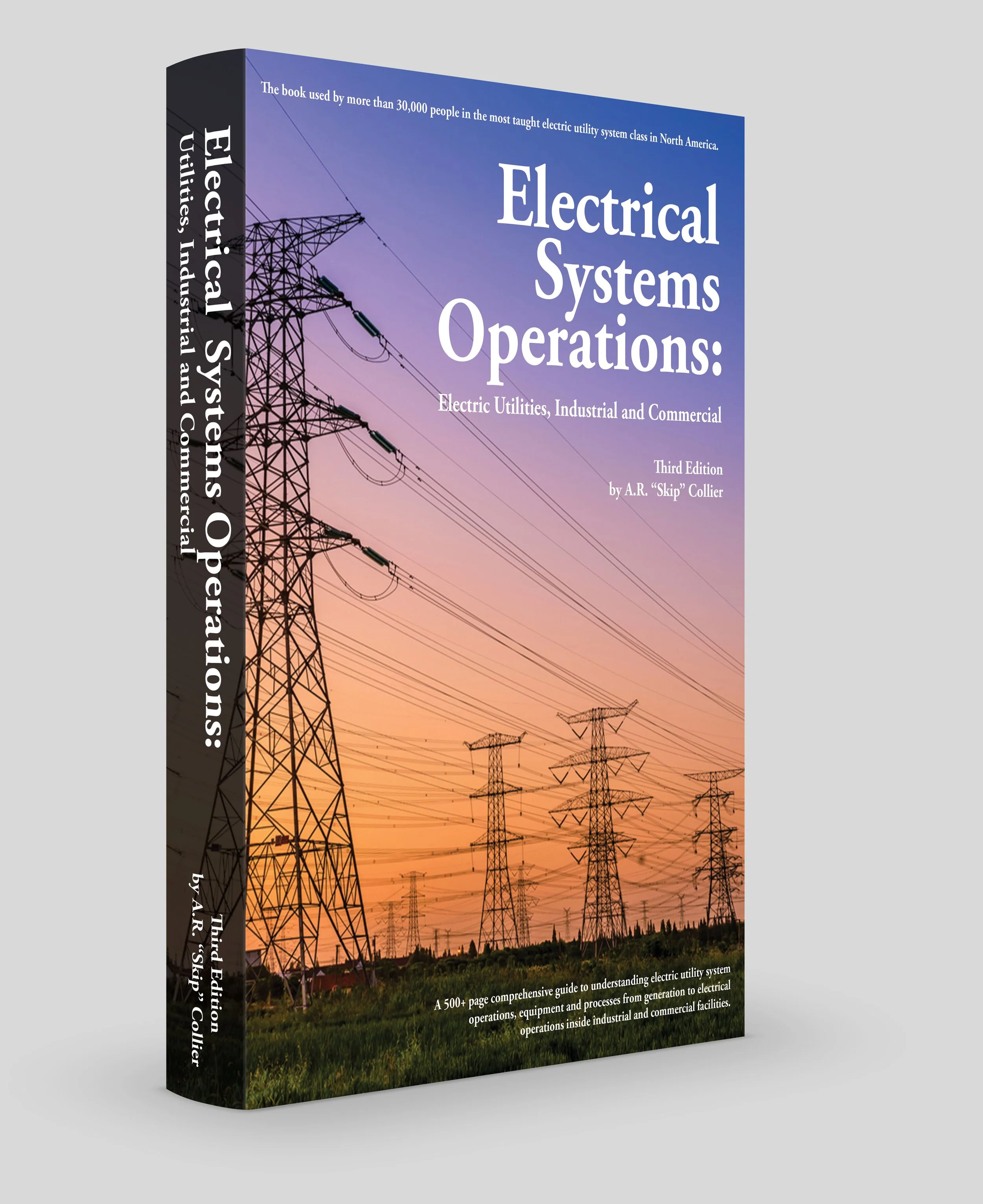
Each attendee receives a 512 page comprehensive book that is the guide to understanding electric utility system operations, equipment and processes from generation to electrical operations inside industrial and commercial facilities. This book provides understanding of electrical systems for those with no electrical background, to experienced compartmentalized electrical engineers who understand that artificial intelligence is demanding an understanding of the entire electrical system. The 3rd edition expands the original book, Electric Utility System Operation, by incorporating the author’s Electric Distribution Systems, Industrial Electrical Systems Operations, and Smart Grid books.
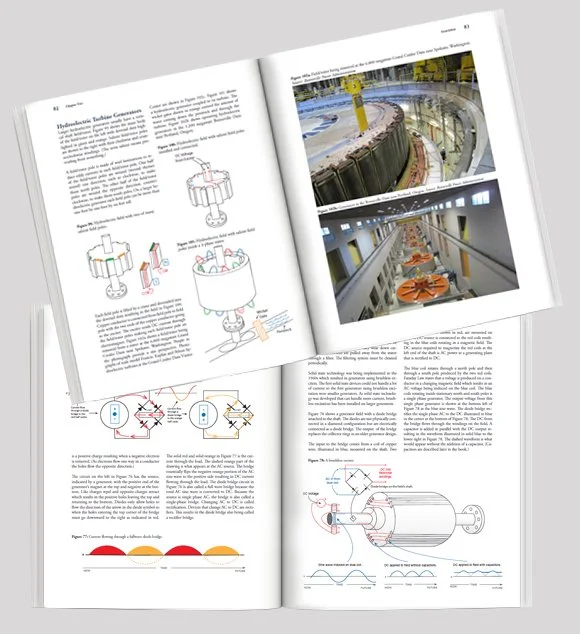
Featuring more than 700 Visuals!
The electric utility book includes custom illustrations, diagrams and photographs that visually explain electrical science, power systems, equipment, and processes. The electric utility systems operations book utilizes a combination of macro photography for close-up examples, detailed color illustrations, and photographs of operating equipment in generation facilities, substations, switchyards, and inside industrial and commercial facilities. This book is the most comprehensive of its kind in the industry in terms of content and supporting visuals.
Each student receives this book that includes narrative and equipment photographs that the instructor references heavily during class. The book is then retained by students as a reference guide throughout their career.
Book Chapters
Electric Fundamentals
Generation
Switchyards & Substations
Impedance
Grid Operations
Distribution System Design
Residential Service
Transformer Testing
DC Transmission & 6-Phase Transmission
Brief History of Electricity and Electric Utilities
Appendix: Series Circuits, Parallel Circuits and Artificial Intelligence
1-day EUSO Topics (8 CEUs)
The 1-day version of the Electric utility System Operation class is used by electric utilities as part of the utilities’ new employee orientation program. It covers the equipment and basic operations from generator to customer. The class explains how electrical energy is created at the various generating resources, and follows the energy into a toaster in a residence.
The class begins with a description of voltage and current for both AC and DC. Single phase and 3-phase generators are explained including how generators are built and the advantages of 3-phase. The methods used to spin a generator’s rotor come next describing steam, water (hydroelectric), wind, jet engines (gas turbines), reciprocating engines and tidal action. This is followed by a description of an electrical system from generator to house, as a preview of what will be covered, showing the substations with their transformers, transmission lines and distribution lines.
The relationships of voltage, current, power, demand, load and energy come next. Substations follow including showing how power transformers are built, how they change voltage and why change in voltage is needed. Circuit breakers, fuses, switches, circuit switchers and lightning arrestors are included in the substation portion of the class. The difference between a substation and switchyard is explained. A residential distribution system is covered including both pole mounted and pad mounted transformers used to bring 120 volts and 240 volts into a house.
The class ends with the instructor taking the class through a system drawing in the book from generation to customer asking the class to identify the equipment they see in three substations and in two switchyards.
Who should attend the 1-Day EUSO class?
New employees who are not in technical jobs and who do not have direct customer contact. This group includes new employees in accounting, legal, HR, finance, internal and external communications, and those who purchase office supplies and office equipment.
Pricing
$9,000 for the first 24 and $375 for each additional person, plus instructor expenses from Portland, Oregon and shipping of books and demonstration items.
If you are a smaller municipal utility or co-op without 24 people for a class, have a utility association to which your utility belongs sponsor the class. If the association cannot, we have two recommendations. One is to contact neighboring utilities and determine their interest in jointly sponsoring a class. The second is to email PTS@utilitytraining.netand request a list of other associations who are conducting a class. PTS will provide links to the associations for any classes that are currently scheduled.
View Testimonials by Job Type
2-day EUSO Topics (16 CEUs)
The 2-day version of the Electric Utility System Operation class is designed for people in technical positions who have less than 6 years of experience, and people not in technical positions regardless of years of experience. It covers the equipment and basic operations from generator to customer. The class explains how electrical energy is created at the various generating resources, and follows the energy into a toaster in a residence.
The class begins with a description of voltage and current for both AC and DC. Single phase and 3-phase generators are explained including how generators are built and the advantages of 3-phase. The methods used to spin a generator’s rotor come next describing steam, water (hydroelectric), wind, jet engines (gas turbines), reciprocating engines and tidal action. This is followed by a description of an electrical system from generator to house, as a preview of what will be covered, showing the substations with their transformers, transmission lines and distribution lines.
Grounding is covered next, followed by the relationships of voltage, current, power, demand, load and energy. Substations come next beginning with the power transformer, showing how it is built, the wye versus delta connections, cooling systems, and methods of preventing water from getting into a transformer. Other standard substation equipment is then covered including circuit breakers, circuit switchers, fuses, voltage transformers, current transformers and protective relays. The difference between a substation and switchyard is explained.
Pole mounted and pad mounted transformers serving customers are covered followed by voltage control in substations and in distribution lines using load tap changers (LTC,TCUL, OLTC), no load tap changers (NLTC) and voltage regulators. Autotransformers and lightning protection are included. Because a power transformer is the most important piece of equipment in a substation. and everything in a substation is there for the power transformer, every item on a power transformer nameplate is explained using a photograph in the book of the nameplate.
The class ends with the instructor taking the class through a system drawing in the book from generation to customer asking the class to identify the equipment they see in three substations and in two switchyards.
Who should attend the 2-day EUSO class?
New employees in IT who are responsible for employee support and customer billing, new employees who purchase electrical equipment and electrical supplies, CSRs, new warehouse personnel, and new employees in vegetation management. Experienced employees in accounting, legal, HR, finance, internal and external communications, and those who purchase office supplies and office equipment. Note: Many who take the 1-day version take the 2-day version a year or two later once they gain experience.
Pricing
$12,700 for the first 24 and $530 for each additional person, plus instructor expenses from Portland, Oregon and shipping of books and demonstration items.
If you are a smaller municipal utility or co-op without 24 people for a class, have a utility association to which your utility belongs sponsor the class. If the association cannot, we have two recommendations. One is to contact neighboring utilities and determine their interest in jointly sponsoring a class. The second is to email PTS@utilitytraining.netand request a list of other associations who are conducting a class. PTS will provide links to the associations for any classes that are currently scheduled.
View Testimonials by Job Type
3-day EUSO Topics (24 CEUs)
The 3-day version of the EUSO class is designed for employees in highly technical positions, and the account executives in electric utilities assigned to work with large industrial and large commercial customers. In addition to the topics covered in the 2-day EUSO class, the 3-day version covers the topics listed below.
A significant portion of the 3-day version also covers real time operations including:
Generator governor control to produce megawatts
Generator excitation control to produce megavars
What reactive power(VAr) is, its causes and its remedies and power factor. Two and
one-half hours are dedicated to these topics to ensure students really understand.
How energy is transmitted (wheeled) through several utilities ending hundreds of miles away
Loop flow
The interaction of generator governor control, Automatic Generation Control (AGC) and Area Control Error (ACE) in matching generation to load
Reliability organizations including NERC, Regional Transmission Organizations and FERC
The roles of blackouts, brownouts, demand response, real time pricing and underfrequency load shedding in matching generation to load
How electric utilities schedule generating resources in real time, using both price and location in scheduling both megawatts and megavars.
Stability issues resulting when many large generators are retired and replaced by wind and solar
SCADA remotely monitoring and controlling equipment
Another significant portion of the 3-day version is how utilities schedule generation resources years in advance of actual need. The challenges presented by opposition to building transmission lines while artificial intelligence data centers and electric vehicles have greatly increased load projections is included in the 3-day version.
Additional topics in the 3-day version are:
The 6-phase prototype transmission lines
Why DC transmission is more efficient than AC?
Why DC is so rare and why it will be more common
Who should attend the 3-day EUSO class?
Generation
Generator operators
Generation auxiliary operators
Generation schedulers
Engineers & Engineering Support
Electrical engineers new to electric utilities
Electrical engineers specialized in one area, who want to expand their career opportunities
Other engineering disciplines considering transitioning into electrical engineering positions
(see below)Engineering technicians
Staking engineers
GIS technicians
Generation
Generator operators
Generation auxiliary operators
Generation schedulers
Transmission & Distribution
Transmission & distribution operators
Transmission schedulers
Employees responsible for cost-of-service studies
Information technology
IT professionals responsible for SCADA & EMS systems
IT professionals responsible for employee support and billing software who want to transition into SCADA & EMS
Line, Substation and Ground Crews
Journey level
Apprentice level
Apprenticeship instructors
Rates & Billing
Entry level metering engineers and metering technicians responsible for installing, testing and maintaining meters used for billing
IT professionals responsible for writing code for accurate customer billing
IT professionals responsible for implementing artificial intelligence for real time pricing
and load control
Those working on strategic planning including
Planning for new peaking generation resources due to real-time pricing changing daily demand curves
Planning for new transmission lines, or transmission upgrades, due to real-time pricing changing daily demand curves
Planning for implementing artificial intelligence (AI) for load control and real time pricing
Planning for communication systems upgrades due to AI for load control and real time pricing
Planning for reimbursing large numbers of customers with in-house generation that exceeds consumption using daily demand curves and annual demand curves
Note regarding other engineering disciplines transitioning into electrical engineering positions.
Most engineering disciplines have more than enough mathematics to work as electrical engineers in an electric utility, particularly mechanical, nuclear, civil, structural and chemical engineers. Understanding the electrical side is simple compared to the math side.
Southern Company’s Georgia Power
In 2007 Southern Company (Georgia Power, Alabama Power, Mississippi Power, Gulf Power (in Pensacola, FL) and Southern Nuclear) offered an early retirement package that resulted in many more electrical engineers taking the offer than had been projected. There were not enough electrical engineers available to fill the vacancies so a Georgia Power electrical engineer was given the task of developing a comprehensive in-house program to educate other engineering disciplines to work as electrical engineers. The program became, arguably, the best engineering educational program among electric utilities in North America.
PTS’ 3-day Electric Utility System Operation (EUSO) class was selected as the first class in this multi-year education program. Participants in the EUSO classes included mechanical engineers, civil engineers, structural engineers, chemical engineers, industrial engineers and one agricultural engineer.
After attending the EUSO class, engineers performed hands-on training in a non-energized training substation that was built by Georgia Power. This included transformer testing, relay testing, and voltage regulator testing. Oil was drained from the power transformer in the training substation and a door installed to allow engineers to see the interior. Hands-on switching in the non-energized substation was followed by switching at an energized substation.
The hands-on training was augmented by classroom training developed by Georgia Power that included designing distribution systems, fault current studies and coordinating protective devices.
First Energy’s Jersey Central Power & Light (JCP&L)
A mechanical engineer at Jersey Central Power & Light attended PTS’s 3-day Electrical System Operation (EUSO) class five times between 1998 and 2001. Because this was the most times anyone had attended the class, at a subsequent class the EUSO instructor inquired about the mechanical engineer and was told that he had been promoted into an electrical engineering position working with JCP&L’s Key Account Executives. The Key Account Executives work with the largest industrial and commercial customers including resolving technical issues. The mechanical engineer was well versed in compressors, pneumatic and hydraulic systems, and other mechanical systems. His electrical knowledge, along with his personality, made him the ideal candidate for the position.
Pricing
$16,900 for the first 24 and $700 for each additional person, plus instructor expenses from Portland, Oregon and shipping of books and demonstration items.
If you are a smaller municipal utility or co-op without 24 people for a class, have a utility association to which your utility belongs sponsor the class. If the association cannot, we have two recommendations. One is to contact neighboring utilities and determine their interest in jointly sponsoring a class. The second is to email PTS@utilitytraining.netand request a list of other associations who are conducting a class. PTS will provide links to the associations for any classes that are currently scheduled.
View Testimonials by Job Type
Interested in
Attending Classes?
Get alerted when classes are available to attend!
PTS conducts classes at utilities, utility associations, utility conferences and classes where open registration is available.


“I really appreciated the flow of the class and the well thought out progession of the curriculum. I also appreciated the instructor’s ability and willingness to answer any and all questions.”
— Mason Public Utility District, IT Network Administrator